
Stranger In Laurel Hollow: Chapter 1

I am an old man now, writing this down by the light of a coal-oil lamp in the same house where most of it happened. My hands are not as steady as they once were, and the words come slower than they did when I was a boy who thought he could outrun trouble. But I want you to have this story, all of you—my grandchildren and the ones who will come after. The world you are growing up in is already forgetting how thin the line once was between what a man could keep and what could be taken from him with a piece of paper and a hired gun. I do not want you to forget the men who stood on that line.
My name is Thomas Whitman. In the summer I turned thirteen, the summer of 1912, I still answered to Tommy. We lived in Laurel Hollow, a narrow valley cut between two ridges in the mountains. The land had been in our family since before the War Between the States. My father, Eli Whitman, worked it with his hands and with what little help the seasons and his back would allow. My mother, Sarah, kept the house, the garden, and the accounts in her head. We were not rich, and we were not poor in the way some counted such things. We had the land, and the land had us.
My father was a mild man most days. He spoke soft and moved slow around the house. He would sit at the table after supper and listen to my mother talk without interrupting, and when he did speak, it was usually to agree or to ask a question that made her smile. But I had seen the other side of him once, when I was nine. A man from the next hollow had come drunk and mean, shouting at my mother over some old fence line. My father had stepped between them without raising his voice. When the man grabbed for her arm, my father hit him so hard and so sudden that the man went down and did not get up again for a long time. Afterward my father washed the blood from his knuckles at the pump and never spoke of it. I never forgot the look on his face in that moment—quiet, and finished.
My mother used to say, when she thought I was not listening, “Your father is a good man, Tommy. He will not sell what is yours for something as common as money.” She said it like a fact and like a prayer at the same time.
That summer the trouble came in the form of letters and men in clean boots. The Laurel Timber & Coal Company had been buying up mineral rights and surface access all through the ridges. They called it progress. They sent papers that said we had already signed away rights we never knew we had, or that we owed them for timber they claimed had been cut on their side of an old survey line. Most of the men in the hollow signed what was put in front of them or took the money and moved on. My father read every paper twice, folded it carefully, and put it in the drawer of the kitchen table. He would not sell. He told the company men who came to the porch that the land was not his to sell. It was mine, and it would be my children’s after me. He said it plain, without anger, the way a man states the weather.
They did not like that answer.
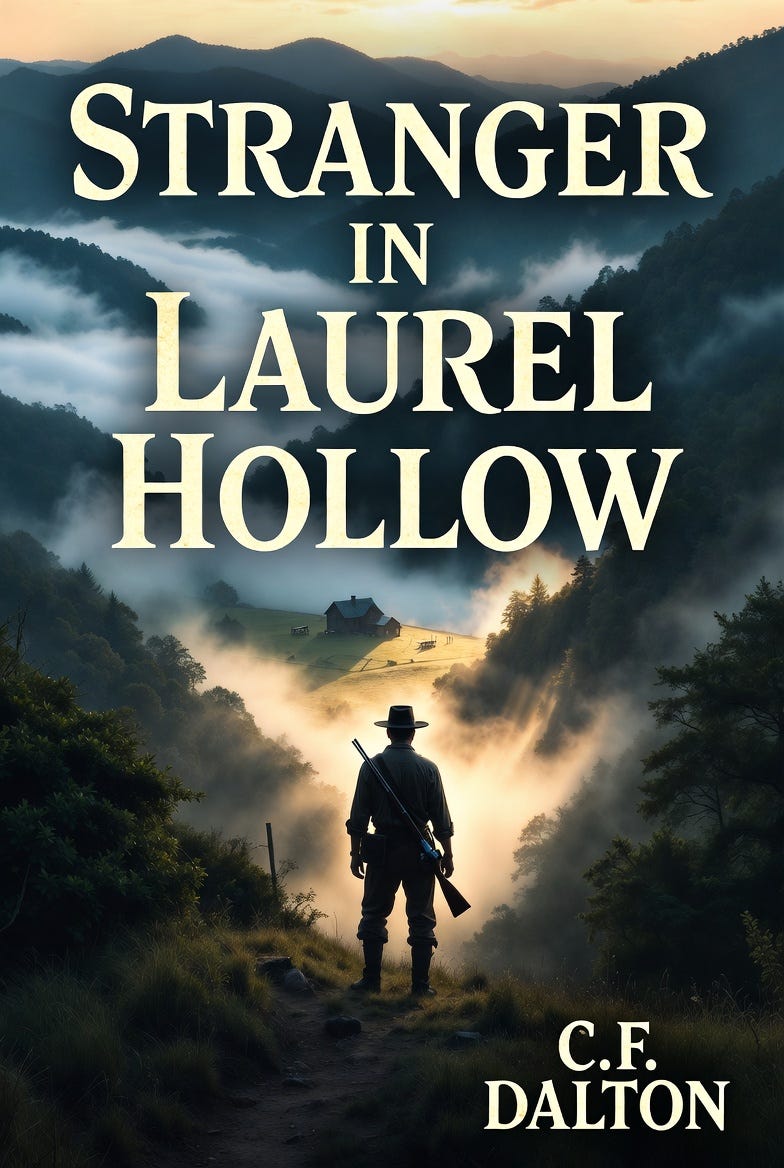
I was splitting wood behind the house one afternoon in late July when I first saw the stranger. He came walking up the trace that ran along the creek, leading a mule that carried a bedroll and a rifle in a scabbard. He was tall and lean, with a slight hitch in his left leg that did not seem to slow him. His clothes were worn but clean. He stopped at the edge of the yard and waited until I looked up.
“You Eli Whitman’s boy?” he asked.
I nodded.
“Name’s Cyril Thompson. I heard there might be work.”
He had the kind of voice that did not need to be raised. I set the axe down and went to fetch my father. When I came back with him, Cyril was still standing in the same place, one hand resting on the mule’s neck. My father studied him for a moment the way he studied a new piece of ground before he broke it.
“You know timber work?” my father asked.
“Some. I know how to work.”
My father glanced at the rifle on the mule, then back at the man’s face.
“We don’t hold with trouble here,” he said.
Cyril nodded once. “Neither do I, when I can help it.”
Something in the way he said it made my father’s shoulders ease a little. He looked at me, then back at Cyril.
“Split what’s left of that wood and you can eat supper with us. After that we’ll see.”
Cyril tied the mule and took the axe from where I had left it. He did not swing it like a man showing off. He swung it like a man who had done the work before and did not mind doing it again. I watched him from the porch steps. There was an old scar across the back of his right hand, pale against the tan, and another that disappeared under his collar when he turned his head. He worked steadily until the pile was done, then washed at the pump the same way my father did, slow and thorough.
At supper my mother asked him where he had come from. He said Cuba, a long time ago, and then the West after that. He did not say more, and she did not press him. My father watched him the way he watched the sky before a storm—measuring, not yet decided. I could not stop looking at the way Cyril held his fork, or the way his eyes moved to the door every so often without seeming to move at all.
After the meal, while my mother cleared the table, my father asked him if he had a place to sleep.
“The barn will do,” Cyril said.
My father nodded. “There’s a stall on the end that’s empty. Mind the mule don’t kick.”
Cyril stood, thanked my mother for the food, and went out into the dark. I followed him as far as the porch. He stopped at the bottom step and looked back at me.
“You got a name, boy?”
“Tommy.”
He studied me a moment longer.
“Get some sleep, Tommy. Tomorrow comes early in a place like this.”
He walked on toward the barn. I stood there until the lamp in the kitchen went out and the only light left was the one in my parents’ room. I could hear my mother’s voice, low and steady, and my father’s shorter answers. I could not make out the words, but I knew she was telling him again that he was a good man.
I went to my bed in the loft and lay awake a long time, listening to the creek and to the sound of the mule shifting in the stall below. I did not know then what Cyril Thompson had brought with him into Laurel Hollow. I only knew that the air in the house felt different with him under the same roof, and that for the first time in weeks my father had not looked tired when he went to bed.
That was the beginning. Everything that came after started with a man walking up the trace with a mule and a rifle and a war behind him that I would not understand for years. I have carried it with me ever since. Now I am giving it to you, so you will know what kind of men once walked these ridges, and what it cost them to stay.